ITXF

The ITXF Methodology

Stop managing change. Start designing the conditions for it.

ITXF is the framework behind that claim. It assesses whether the business, enterprise and transformation architectures agree with each other, and how well a change is being implemented across five factors. Developed through doctoral research and practice.
The ITXF Methodology

Three architectures. Five factors.

ITXF treats transformation as a structural problem, not a communications problem and not a matter of individual willingness. It runs on two layers. Layer one is architectural coherence: whether the business, the enterprise and the transformation architectures agree with each other. The layer above is the five factors that decide whether a change is implemented well. The lower layer sets the ceiling, which is why a well-run programme can still fall short of its objectives.
#1

Business architecture

What the organisation does, what it is good at, and who gets to decide.
#2

Enterprise architecture

What it runs on. Systems, data, and the limits those place on what it can credibly become.
#3

Transformation architecture

How it gets from where it is to where it needs to be. Order, timing, and how much change people can absorb at once.
Held together by Engagement, Communication, Learning and Rewards cross-cutting all three dimensions, Built using the foundations of governance and measurement and people
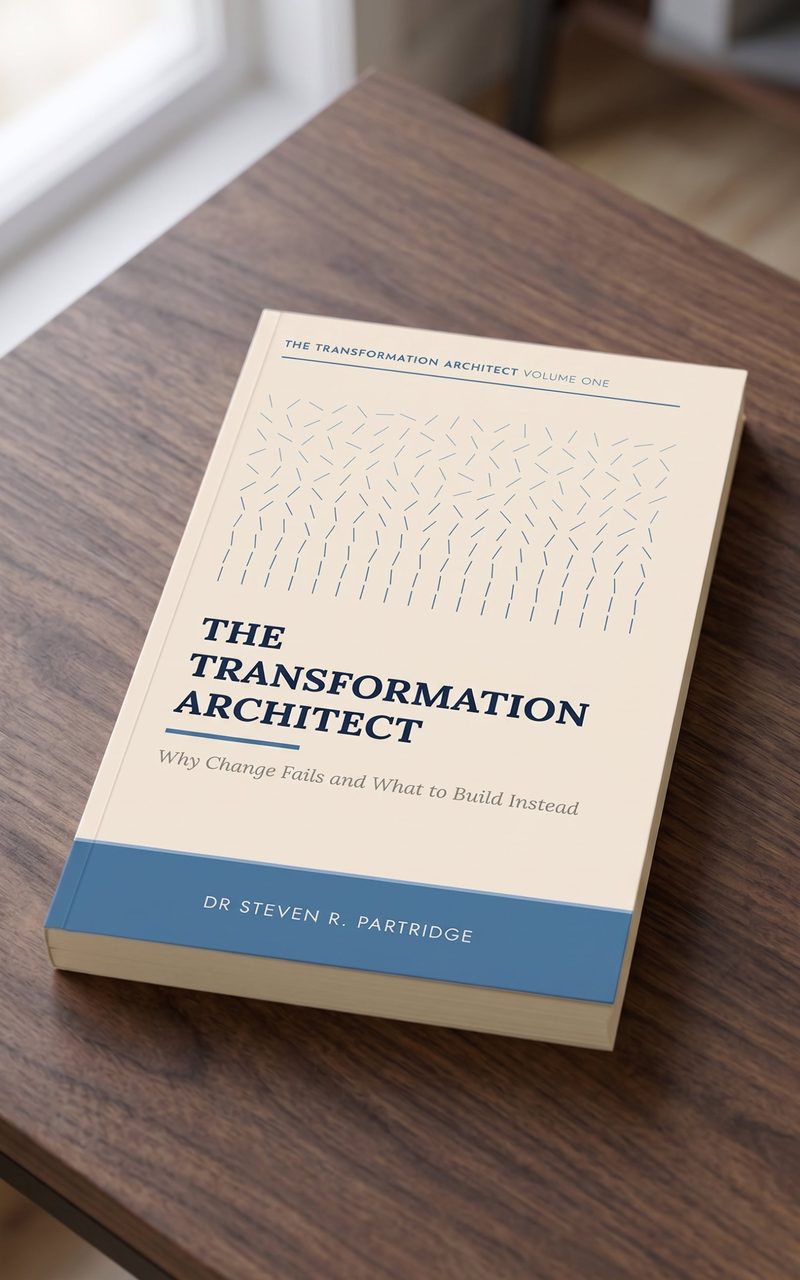
The Transformation Architect, Volume I, by Dr Steven R. Partridge, on a desk by a window

The books

One argument, from every seat.

Change fails in the structure long before it fails in the people. The books set out why, and what to build instead: one for sponsors, one for change practitioners, one for growing companies, and a four-volume series for the people who lead the work.

Volumes I and II are available now. Volume III follows on 1 December.

See all the books
About the author

DR STEVEN R. PARTRIDGE

Dr Steven R. Partridge has spent more than twenty years leading and advising organisational change across the world, mostly in Europe. He holds a Doctorate of Business Administration and a master’s degree in Strategic Quality Management, and is a Scrum Master, a SAFe Release Train Engineer and a Lean Six Sigma Black Belt. He writes on the practice of transformation as The Transformation Architect.

His roles have included Chief Digital Officer, CIO & VP of Transformation, Global Head of Business Architecture, and Head of Lean Six Sigma and Quality. He has led enterprise change at organisations including Novartis, Roche, Zehnder Group, HP and ThyssenKrupp.

Readiness Diagnostic

Where does your organisation actually stand?

21 statements, about seven minutes, one scorecard across seven dimensions. You will get your level on the five-level model, and the dimension most likely to be holding your transformation back. The diagnostic places organisations on the first three levels; the top two require evidence beyond a self-assessment. On completion the report is yours. Reach out if you want to discuss this or our framework in detail.
Sample question · Architecture

Which best describes your Target Operating Model?

Illustrative only. The live tool has 21 statements across seven dimensions.
For Organisations

Bring ITXF into your business

Janovis applies the ITXF methodology as a consulting engagement: maturity assessment, gap analysis, and a structured roadmap delivered by the people who built the framework.
Book a discovery call with Janovis:
For Individual Leaders

Lead the change yourself

If you are facing challenges, whether personal or organisational, I coach leaders directly through my Lead on Three Levels model: Self, Team, System.
Explore coaching at srpartridge.com: